These aren't AI mistakes. They're business basics.
Someone cataloged seven mistakes AI founders are making right now. I've been fixing the same ones for thirty years.
There was an email in my inbox last week that I actually read. The whole thing — every word, every example, all the way to the sign-off.
That almost never happens.
The hook was good. A founder had spent a thousand dollars buying AI tools in a single week and come back with a list of seven mistakes he'd found across dozens of products. I kept reading.
But I didn't buy all of it.
Not because he was wrong. He wasn't, mostly. But because a thirty-year marketer reads a list of marketing failures and sees something different. Less surprise. More recognition.
These are old mistakes wearing new clothes.
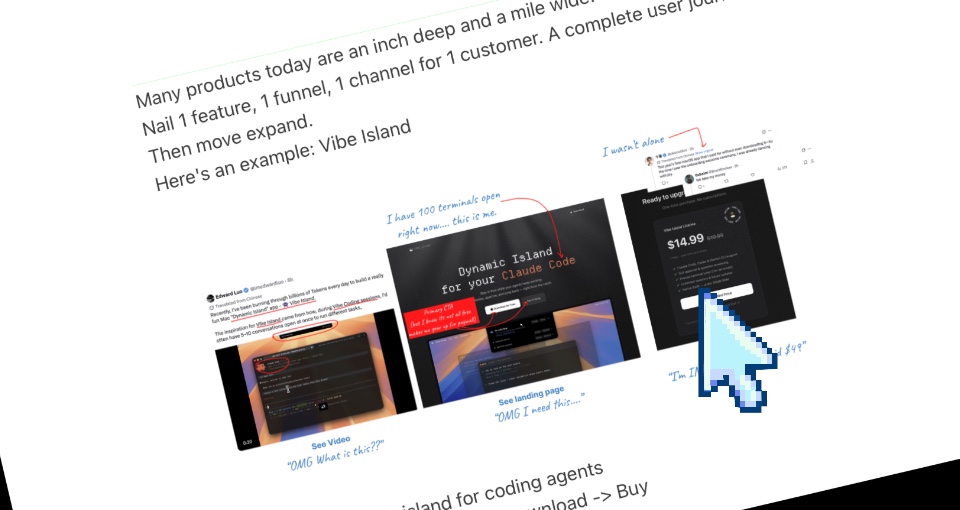
The most damning entry on his list was the simplest. No buy button. He'd land on a page, like what he saw, want to spend money — and have no idea how to pay. No price. No path. Just a dream and a waitlist CTA.
I have seen this exact problem on websites since 1997.
The platform changes. The mistake doesn't.
Same with competing calls to action. Three buttons on one page asking you to do three different things means the person who built the page hasn't decided what they want you to do. That is not a technology problem. That is a thinking problem — and it costs conversions the same way whether you're selling software in 2026 or shoes in 2006.
Gating value behind a login before you've shown anyone what they're getting is no different. That's not a product decision. It's anxiety dressed up as strategy. Give people a reason to create an account. Earn it. Don't demand it as the opening move.
These aren't AI problems. They are the same problems I have been fixing for clients since before most AI founders were in secondary school.
The platform changes. The mistake doesn't.
His fifth point was the best on the list, and it was buried.
Funnels beat features. Not as a preference — as a principle. A complete customer journey, from first contact to payment, matters more than any individual capability a product has. He gave the example of a tool he bought within minutes, then sent to ten friends, because the path from "I found you" to "take my money" was completely frictionless.
One feature. One funnel. One channel. One customer.
That is not an AI insight. That is business. It has always been business.
The founders missing this aren't missing it because they don't understand software. They're missing it because they've been told that shipping is the achievement.
It isn't. Shipping is the beginning. The achievement is getting someone to pay.
The piece frames all of this as a problem specific to AI founders right now. I'd argue it's a problem specific to people who build things without marketing instincts — and that predates AI by several decades.
What AI has done is compress the timeline. You can build something real, ship it publicly, and acquire your first users in a week. That's extraordinary. It's also how you can move through all seven of these mistakes in the same timeframe.
Speed without strategy isn't progress. It's just faster failure.
The other thing the piece doesn't quite name: most of these mistakes come from the same root. Fear. Fear of rejection, dressed up as customer research. Fear of commitment, dressed up as a waitlist. Fear of the wrong answer, dressed up as building another feature.
A buy button is a declaration. It says: I believe this is worth paying for, and I am willing to find out if I'm right.
A lot of founders aren't ready to make that declaration yet. So they build instead.
If you're running a business that's considering AI tools — as a buyer rather than a builder — this list is a useful evaluation checklist. Does the tool have a clear price? A clear next step? Does it do one thing well or ten things vaguely? Did the demo show you something real, or sell you a future the product hasn't arrived at yet? The same questions you'd ask before buying any business software. They haven't changed.
The email mentioned a "voice to video" tool that returned footage of an Italian travel vlogger drinking wine in a vineyard when the founder talked about his business. That's not a quirk. That's a signal. The product isn't what it says it is — and the marketing knew it.
Thirty years of building for the web has taught me one thing above everything else.
The fundamentals do not change. The technology changes around them.
Clarity. Proof. A single ask. A reason to trust. These weren't invented for the internet. They weren't invented for AI. They have been the job since there was a job to do.
If you're trying to work out what AI can actually do for your business — separate from the hype — that conversation starts here.